
SkillStrat Consulting

Scheduled Maintenance: Our website will be undergoing maintenance on 18th July, 12:00 AM – 1:00 AM (IST). During this period, the site may be temporarily unavailable.

4.63
(8 Ratings)

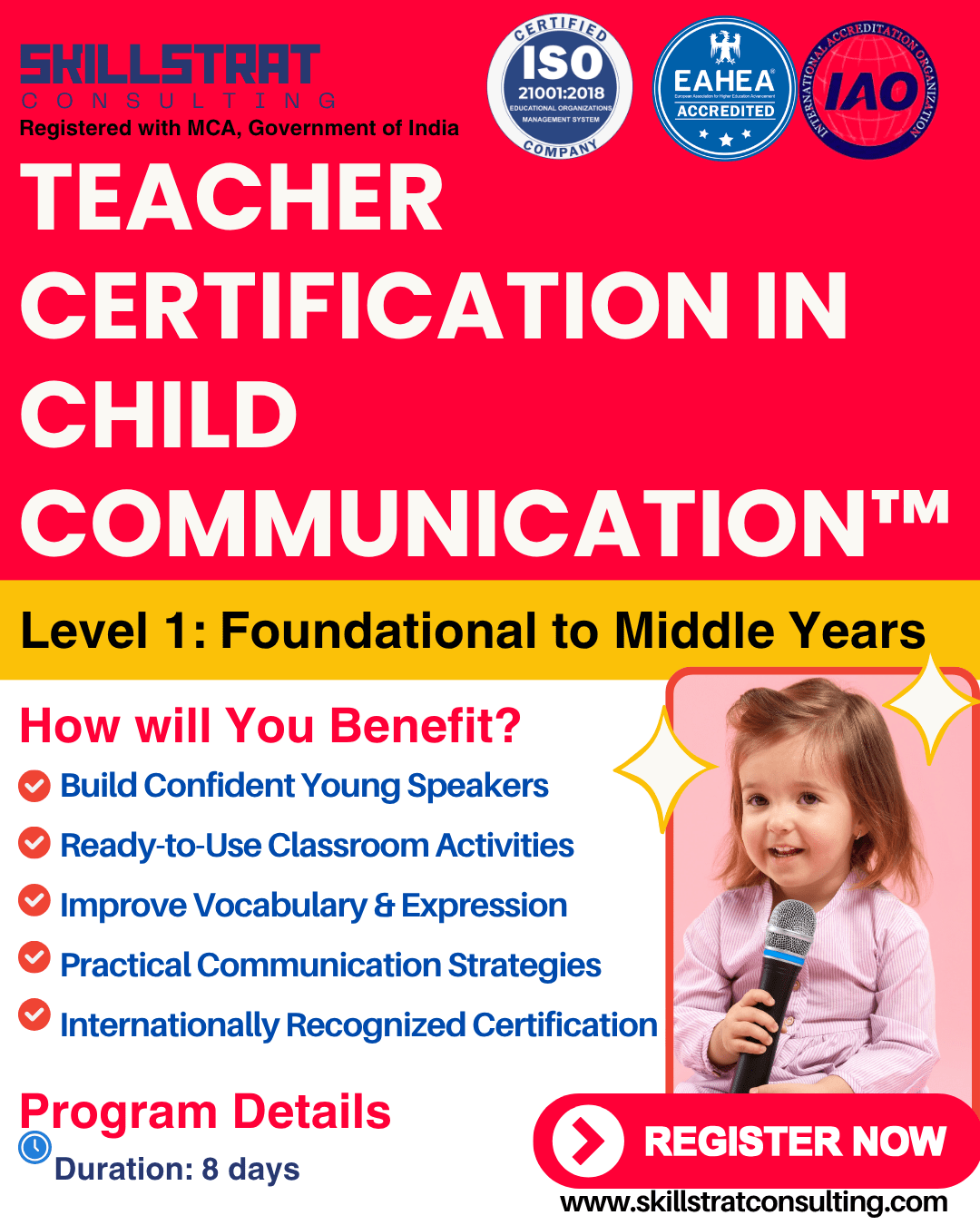
Teacher Certification in Child Communication™

Wishlist Share

About Course

Communication is one of the most important life skills a child develops, yet many classrooms focus primarily on academic content rather than communication itself. This certification equips teachers with practical, classroom-ready strategies to intentionally develop children’s listening, speaking, vocabulary, conversation, storytelling, and expressive language skills across the school day.

Designed for teachers working with children from the foundational years through middle school, this program combines child development principles with engaging, activity-based teaching strategies that can be implemented immediately. Participants will learn how to create communication-rich classrooms where every child feels confident to think, express, collaborate, and communicate effectively.

Show More

What Will You Learn?

  • MODULE 1: FOUNDATIONS OF CHILD COMMUNICATION
  • - Why child communication matters
  • - Communication as the foundation of learning
  • - The brain behind child communication
  • - The B.R.A.I.N. Communication Framework
  • - The teacher’s role in building a child’s voice
  • - The communication chain from input to expression
  • MODULE 2: LANGUAGE DEVELOPMENT AND VOCABULARY BUILDING
  • - How children build meaning through language
  • - Moving from words to meaningful sentences
  • - The sentence development ladder
  • - Expanding sentences with details
  • - Connecting ideas with and, but, because and so
  • MODULE 3: ATTENTION AND LISTENING SKILLS
  • - Sensory awareness before listening
  • - Teaching focused and sustained attention
  • - Selective, alternating and divided attention
  • - Listening for information and details
  • - Following instructions, auditory memory and listening comprehension
  • MODULE 4: THINKING AND THOUGHT ORGANISATION
  • - Why children struggle to organise thoughts
  • - Identifying the main idea
  • - Sequencing thoughts clearly
  • - Developing ideas with reasons and examples
  • - Connecting ideas and building complete responses
  • MODULE 5: EMOTIONAL SAFETY AND COMMUNICATION CONFIDENCE
  • - Why children fear speaking
  • - Building speaking comfort
  • - Speaking without fear of mistakes
  • - Expressing thoughts and opinions
  • - Speaking to different audiences
  • - Managing nervousness before speaking
  • MODULE 6: SPEECH CLARITY, VOICE AND FLUENCY
  • - Understanding speech clarity and fluency
  • - Articulation and clear sound production
  • - Pronunciation and enunciation
  • - Accent, intelligibility and voice control
  • - Pitch, intonation, pace and pauses
  • - Stress, emphasis and fluent delivery
  • MODULE 7: CONVERSATION AND SOCIAL COMMUNICATION SKILLS
  • - The five core conversation skills
  • - Starting a conversation
  • - Responding and keeping the conversation going
  • - Staying on topic
  • - Closing a conversation naturally
  • MODULE 8: EXPRESSIONS AND BODY LANGUAGE
  • - Why body language matters in communication
  • - Personal space and distance
  • - Body orientation and posture
  • - Gestures and hand movements
  • - Eye gaze and facial expressions
  • - Reading and using body language appropriately
  • MODULE 9: FROM SKILLS TO CLASSROOM PRACTICE
  • - Identifying where communication breaks down
  • - Correcting without killing communication
  • - Building a spiral child communication curriculum

Course Content

Module 1: Foundations of Child Communication
Understand how children develop communication skills from the foundational years to middle school and explore the teacher's role in building confident communicators.

  • Lesson 1: How and Why Children Communicate
  • Lesson 2: The teacher’s role in building a child’s voice
    00:00
  • Lesson 3: The brain behind child communication
    00:00
  • Lesson 4: The B.R.A.I.N. communication framework
    00:00
  • Lesson 5: The communication chain

Module 2: Attention & Listening Skills
In this module, participants learn how attention and listening form the foundation of child communication. Before children can understand, respond or speak meaningfully, they must first learn to notice information, focus on what matters, sustain attention, filter distractions and process spoken language. This module helps teachers identify different attention skills and develop practical classroom strategies for improving listening, instruction-following, auditory memory and listening comprehension.

Module 3: Emotional Safety And Communication Confidence
In this module, participants learn how emotional safety affects a child’s willingness to communicate. Children do not become confident speakers only by being told to speak. They become confident when they repeatedly experience that speaking is safe, mistakes are accepted and their voice is valued. This module helps teachers understand why children fear speaking and how to build communication confidence gradually. Participants learn strategies to help children speak comfortably, express thoughts and opinions, speak without fear of mistakes, adapt to different audiences and manage nervousness before speaking.

Module 4: Language Development & Vocabulary Building
In this module, participants learn how children develop language by connecting words with meaning, experience and thought. Children do not build communication by memorising random words. They build communication when they understand what words mean, how words connect to ideas, and how ideas can be expressed through sentences. This module focuses on helping teachers move children from single words and fragments towards clear, meaningful and connected sentences.

Module 5: Thinking and Thought Organization
In this module, participants learn how to help children organise their thoughts before speaking. Many children may know the answer but struggle to express it clearly because they do not know what to say first, what to add next or how to complete their response. This module focuses on building the mental structure behind communication. Participants learn practical strategies to help children identify the main idea, sequence thoughts, develop ideas, connect responses and speak in a more organised way.

Module 6: Speech Clarity, Voice And Fluency
In this module, participants learn how to help children speak in a way that others can understand clearly. Speech clarity is not only about pronunciation. It includes articulation, enunciation, voice, volume, pitch, pace, pauses, stress and overall intelligibility. This module helps teachers identify what exactly is affecting a child’s speech clarity and choose the right classroom strategy. Participants learn how to support clear sound production, correct word pronunciation, clearer delivery, appropriate volume, expressive voice and natural speaking rhythm.

Module 7: Conversation And Social Communication Skills
In this module, participants learn how to help children participate in real conversations, not just answer questions. Conversation requires children to initiate, respond, add information, ask back, stay on topic and close interactions appropriately. This module also introduces the social side of communication, where children learn how to join conversations, keep them going, understand topic connection and communicate naturally with others. Participants learn practical techniques for building conversation skills through structured classroom practice and real-life interaction.

Module 8: Expressions And Body Language
In this module, participants learn how children communicate through the body, face and movement, even when they are not speaking. Non-verbal communication includes facial expressions, eye gaze, gestures, posture, body orientation and personal space. This module helps teachers teach children how to read body language and use it appropriately in communication. Participants learn how body language affects listening, confidence, social interaction and classroom participation.

Module 9: From Skills To Classroom Practice
In this final module, participants learn how to apply the complete child communication framework in real classroom situations. After learning attention, listening, language, thought organisation, confidence, speech clarity, conversation and body language, teachers must know how to identify where communication is breaking down and how to support children without discouraging them. This module helps participants move from broad labels like “poor communication” or “not listening” to more accurate classroom observation. Participants also learn how to correct children gently, avoid common communication mistakes and understand how child communication skills can grow across age groups through a simple spiral curriculum.

Module 10: Assessment
This final assessment checks the participant’s understanding of the complete Child Communication Certification program. It assesses key concepts from child communication foundations, attention and listening, language development, thought organisation, emotional safety, speech clarity, conversation skills, body language and classroom application. The purpose of this assessment is not only to test memory. It helps participants reflect on how they will identify communication difficulties and support children through practical classroom strategies.

Student Ratings & Reviews

4.6
Total 8 Ratings
5
5 Ratings
4
3 Ratings
3
0 Rating
2
0 Rating
1
0 Rating
JA
8 hours ago
Yes, very informative and useful
SS
2 weeks ago
it was nice and well organized course
NJ
4 weeks ago
Good
DS
1 month ago
It was a best course
PJ
1 month ago
It was extremely insightful & helpful course. Thank u team Skillstart
TJ
1 month ago
Perfect course which improved me... so Detailed course to rely on
SR
2 months ago
Great
RA
2 months ago
nice

Want to receive push notifications for all major on-site activities?

✕