SkillStrat Consulting

Scheduled Maintenance: Our website will be undergoing maintenance on 18th July, 12:00 AM – 1:00 AM (IST). During this period, the site may be temporarily unavailable.

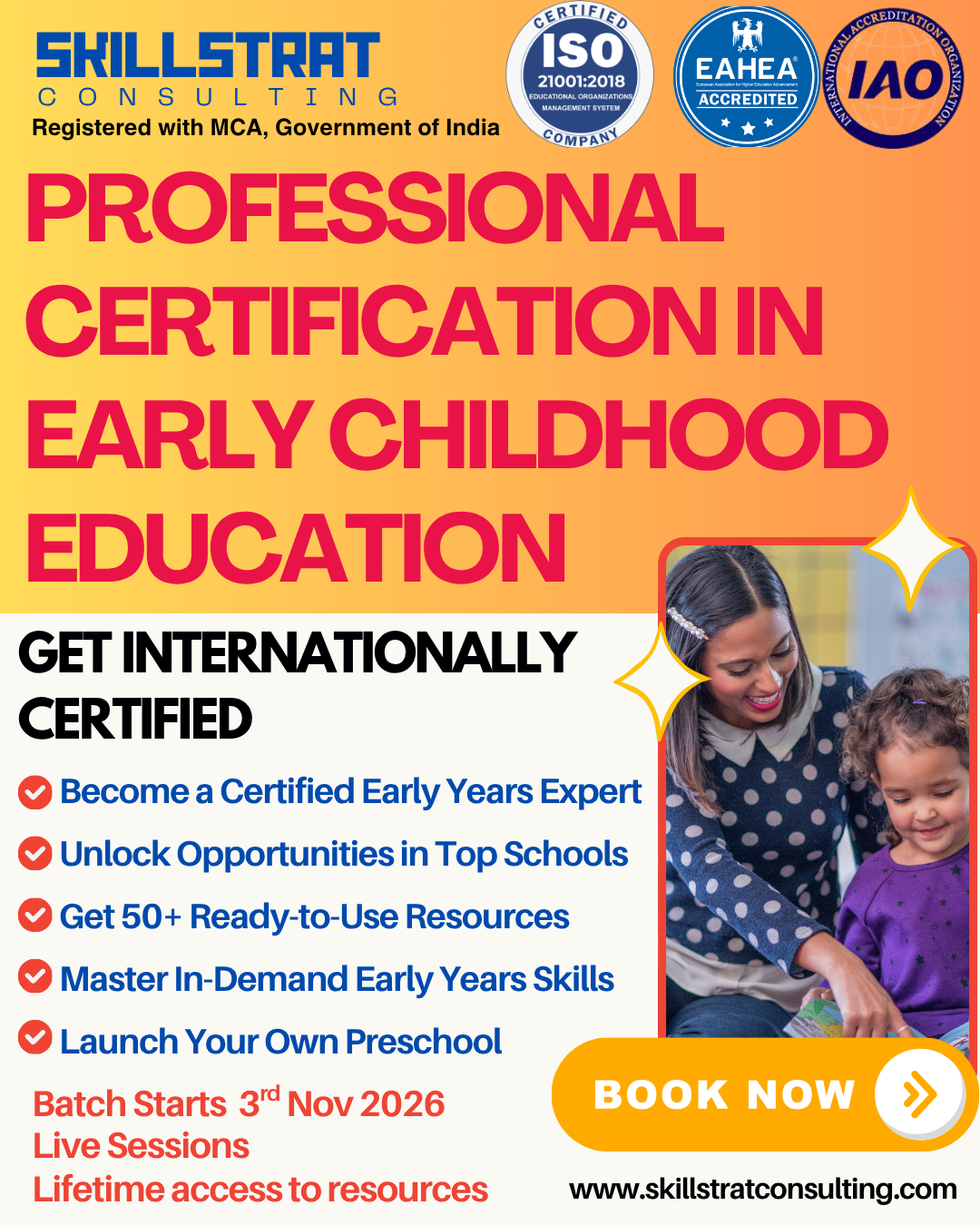
Professional Certification in Early Childhood Education

Wishlist Share

About Course

This intensive 21-day certification program prepares aspiring and practising educators to create joyful, inclusive and developmentally appropriate learning experiences for young children.

Participants will gain practical expertise in child development, early brain development, play-based learning, classroom management, learning centres, emergent literacy, foundational numeracy, social-emotional learning, positive guidance, inclusion, lesson planning and observation-based assessment.

The program includes hands-on activities, practical assignments, classroom-ready strategies and 50+ templates and teaching resources that can be used immediately.

By the end of the program, participants will be equipped to work confidently in preschools and foundational-stage classrooms, pursue early-years leadership opportunities or take the first step towards starting their own preschool.

Show More

What Will You Learn?

  • Module 1: Foundations of Early Childhood Education
  • Purpose and principles of early childhood education
  • Role of an early childhood educator
  • Understanding the Foundational Stage
  • Developmentally appropriate teaching practices
  • Creating joyful and child-centred learning experiences
  • NEP 2020 and NCF-FS guidelines
  • Module 2: Child Development and the Early Brain
  • Physical, cognitive, language and emotional development
  • Age-wise developmental milestones
  • How the young brain learns
  • Attention, memory and executive functioning
  • Understanding individual developmental differences
  • Recognising developmental concerns and referral needs
  • Module 3: Play-Based and Experiential Learning
  • Importance of play in early learning
  • Types and developmental stages of play
  • Free play, guided play and structured play
  • Learning through art, stories, music and movement
  • Designing meaningful hands-on experiences
  • Using everyday materials as learning resources
  • Module 4: Classroom Environment and Learning Centres
  • Designing an age-appropriate classroom
  • Creating literacy, numeracy and sensory centres
  • Setting up art and pretend-play areas
  • Planning engaging circle-time sessions
  • Establishing effective routines and transitions
  • Creating low-cost teaching-learning materials
  • Module 5: Communication and Emergent Literacy
  • Developing listening and speaking skills
  • Building vocabulary and sentence formation
  • Storytelling, rhymes and picture conversations
  • Print awareness and pre-reading readiness
  • Phonological awareness and sound activities
  • Pre-writing and fine-motor development
  • Supporting multilingual learners
  • Module 6: Foundational Numeracy and Discovery
  • Building number sense
  • Sorting, matching, comparing and classifying
  • Teaching patterns, shapes and spatial awareness
  • Introducing measurement through everyday experiences
  • Developing early scientific thinking
  • Using games and manipulatives for numeracy
  • Module 7: Social-Emotional Learning and Positive Guidance
  • Helping children recognise and express emotions
  • Building confidence, independence and empathy
  • Developing sharing and cooperation skills
  • Understanding challenging behaviour
  • Using positive discipline and age-appropriate boundaries
  • Supporting emotional regulation
  • Managing tantrums, conflicts and separation anxiety
  • Module 8: Inclusive and Differentiated Learning
  • Understanding diverse learning needs
  • Recognising different learning profiles
  • Supporting children with developmental delays
  • Adapting activities, instructions and materials
  • Creating sensory-friendly learning experiences
  • Encouraging participation without labelling
  • Collaborating with families and support professionals
  • Module 9: Curriculum Planning and Assessment
  • Creating daily, weekly and thematic plans
  • Writing age-appropriate learning outcomes
  • Balancing child-led and educator-led learning
  • Planning integrated learning experiences
  • Observing children during authentic activities
  • Using anecdotal records, checklists and portfolios
  • Documenting progress without formal testing
  • Module 10: Safety, Family Partnership and Professional Practice
  • Health, hygiene and classroom safety
  • Child protection and safeguarding
  • Responding to common classroom emergencies
  • Communicating children’s progress to parents
  • Managing challenging parent conversations
  • Maintaining confidentiality and professional boundaries
  • Ethics and responsibilities of an early childhood educator

Student Ratings & Reviews

No Review Yet
No Review Yet

Want to receive push notifications for all major on-site activities?