
SkillStrat Consulting

Scheduled Maintenance: Our website will be undergoing maintenance on 18th July, 12:00 AM – 1:00 AM (IST). During this period, the site may be temporarily unavailable.

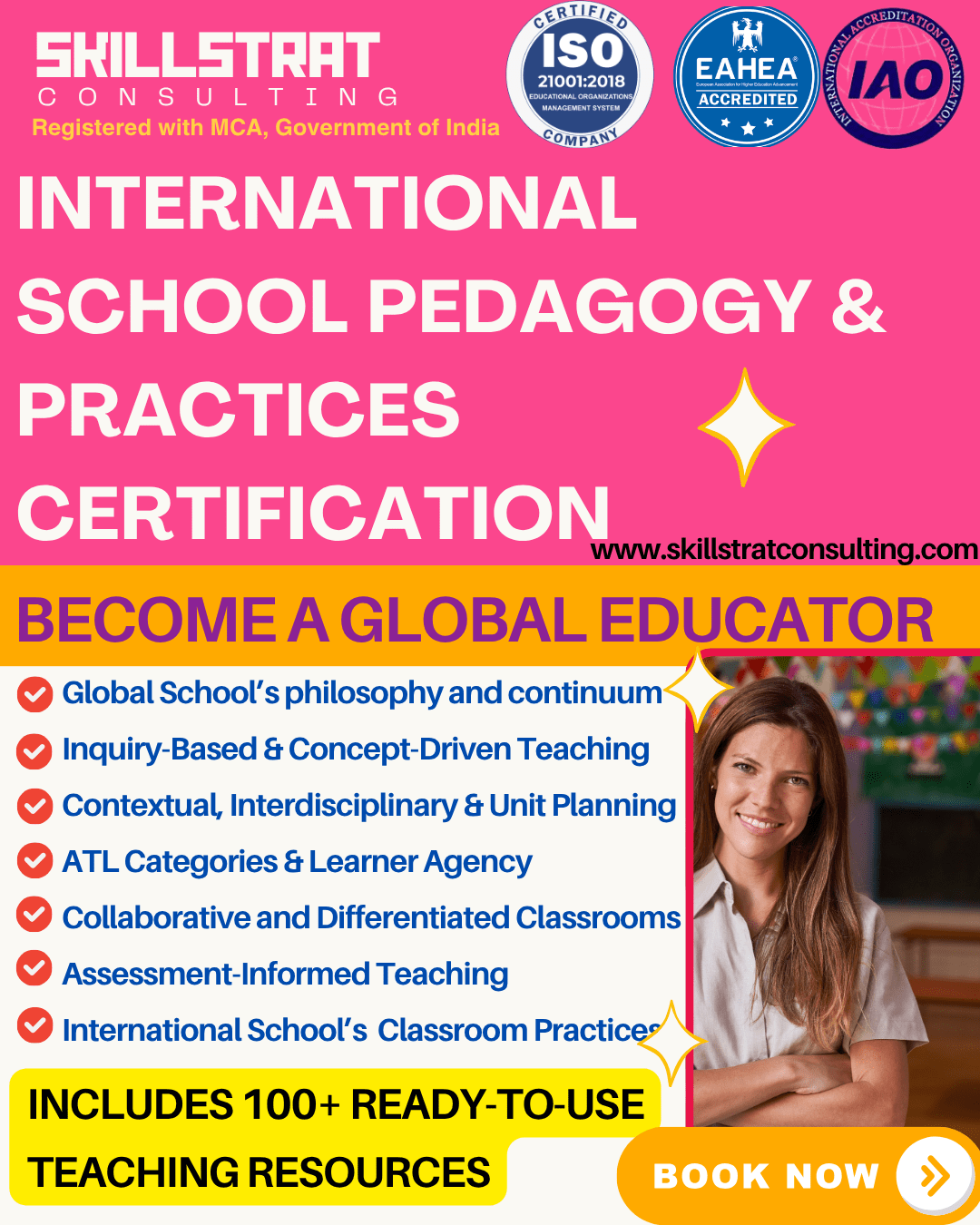
INTERNATIONAL SCHOOL PEDAGOGY & PRACTICES CERTIFICATION

Wishlist Share

About Course

Welcome to your journey towards becoming a global educator!

The International School Pedagogy & Practices Certification is designed for educators who want to understand and apply the teaching approaches commonly expected in international school environments.

The program moves beyond curriculum knowledge and focuses on how learning is planned, facilitated and assessed in inquiry-led, concept-driven and learner-centered classrooms. You will develop the skills to create meaningful learning experiences, connect concepts across disciplines, strengthen learner agency, differentiate instruction and use assessment evidence to improve teaching.

BY THE END OF THE PROGRAM, YOU WILL BE ABLE TO:

• Understand the mindset and responsibilities of an international school educator
• Design inquiry-led and concept-driven learning experiences
• connect classroom learning with relevant local and global contexts
• Develop students’ thinking, communication, research, social and self-management skills
• Create opportunities for student voice, choice and ownership
• Plan collaborative and differentiated classroom experiences
• Design authentic assessments, rubrics and feedback processes
• Prepare an international school-style unit plan and classroom demonstration

Show More

What Will You Learn?

  • • International education philosophy and curriculum frameworks
  • • Inquiry-based and concept-driven teaching
  • • Contextual, interdisciplinary and unit planning
  • • Learning skills and learner agency
  • • Collaborative, inclusive and differentiated classrooms
  • • Assessment-informed teaching and feedback
  • • Classroom practices for international schools

Course Content

MODULE 1: FOUNDATIONS OF INTERNATIONAL SCHOOL EDUCATION
Explore what distinguishes international school education from conventional content-driven teaching. Participants will understand international education philosophies, curriculum frameworks, global-mindedness, holistic development and the evolving role of the educator.

  • Lesson 1: What Makes an International School Classroom Different?

MODULE 2: INQUIRY-BASED TEACHING AND LEARNING
Learn how to transform curiosity into meaningful learning. This module covers the inquiry process, different levels of inquiry, provocations, questioning techniques and strategies that help students investigate, discuss, discover and construct understanding.

MODULE 3: CONCEPT-DRIVEN AND CONTEXTUAL LEARNING
Move beyond teaching isolated facts and help students develop transferable understanding. Participants will learn how to identify important concepts, frame conceptual questions and connect classroom learning with relevant local, global and real-world contexts.

MODULE 4: INTERDISCIPLINARY LEARNING AND UNIT PLANNING
Learn how to design connected learning experiences across subjects and disciplines. Participants will use backward planning to align concepts, learning outcomes, activities, resources and assessments within a structured international school-style unit plan.

MODULE 5: LEARNING SKILLS AND LEARNER AGENCY
Develop students’ thinking, communication, research, social and self-management skills. This module also explores student voice, choice, ownership, goal-setting and reflection to help learners become more independent and responsible.

MODULE 6: COLLABORATIVE, INCLUSIVE AND DIFFERENTIATED CLASSROOMS
Create classrooms where every learner can participate and progress. Participants will explore collaborative learning structures, flexible grouping, scaffolding and practical ways to differentiate content, process, support and learning products.

MODULE 7: ASSESSMENT-INFORMED TEACHING
Use assessment as a continuous process for improving learning. This module covers diagnostic, formative and summative assessment, success criteria, rubrics, authentic tasks, effective feedback, self-assessment and peer assessment.

MODULE 8: INTERNATIONAL CLASSROOM PRACTICE AND FINAL PRACTICUM
Bring all the program learning together through practical classroom application. Participants will develop an inquiry-led unit plan, design an assessment task, conduct a short lesson demonstration and reflect on their readiness to facilitate an international school classroom.

Student Ratings & Reviews

No Review Yet
No Review Yet

Want to receive push notifications for all major on-site activities?