SkillStrat Consulting

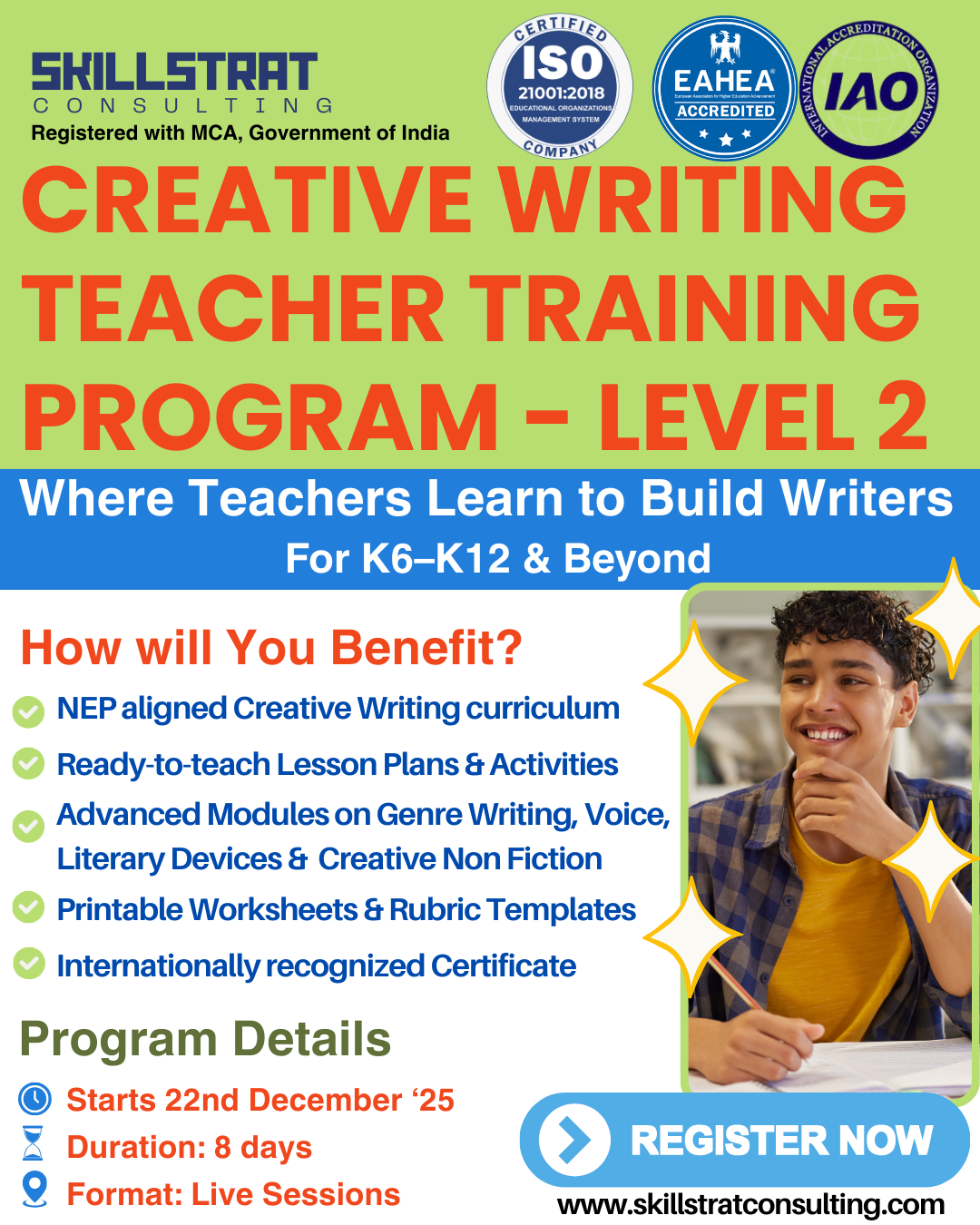
CREATIVE WRITING TEACHER TRAINING PROGRAM – LEVEL 2

Wishlist Share
Share Course
Page Link
Share On Social Media

About Course

The Creative Writing Teacher Training Program – Level 2 is designed for educators who are ready to go beyond the basics and dive deeper into advanced creative writing pedagogy.
This 8-day intensive course helps you move from teaching how to write to how to think, feel, and express ; empowering students to write with voice, structure, and purpose.

Through hands-on practice, genre-based modules, and classroom-tested lesson templates, you’ll learn how to teach writing that connects emotionally, builds creativity, and develops critical literacy across middle, secondary, and higher education levels.

This isn’t just about teaching writing, it’s about mentoring young authors and helping them discover their voice.

Show More

What Will You Learn?

  • By the end of this program, you will be able to:
  • ✅ Teach advanced creative writing elements — genre, theme, voice, and tone
  • ✅ Design lessons for narrative, descriptive, and reflective writing
  • ✅ Guide students in crafting character-driven stories and persuasive non-fiction
  • ✅ Use flash fiction, and memoirs as tools for creative expression
  • ✅ Introduce literary devices like symbolism, irony, and imagery with ease
  • ✅ Facilitate writing circles, peer reviews, and mini-workshops
  • ✅ Assess student writing through authentic rubrics and feedback frameworks
  • ✅ Build your own creative writing curriculum for K6–K12 and college-level learners

Course Content

Day 1: Advanced Story Structure – The 3-Act Model & Hero’s Journey
Learning Outcomes: Understand the 3-Act Story Framework and Hero’s Journey. Teach students how to develop rising action, climax, and resolution. Guide learners in structuring essays, short stories, and scripts

Day 2: Building Character Depth & Voice
Learning Outcomes: Teach students to create complex, believable characters. Differentiate between author’s voice, narrator’s voice, and character’s voice. Use dialogue and action to reveal personality.

Day 3: Setting, Mood & Atmosphere
Learning Outcomes: Teach how to use sensory details to create atmosphere. Introduce the use of metaphor, simile, and imagery for setting. Integrate geography, science, and history contexts into creative writing

Day 4: Genre Writing – Narrative, Descriptive & Reflective
Learning Outcomes: Differentiate between narrative, descriptive, and reflective writing. Teach purpose-driven writing (storytelling, journaling, essays). Introduce hybrid genres — memoirs, creative nonfiction.

Day 5: Literary Devices & Style Mastery
Learning Outcomes: Teach students to use repetition, symbolism, contrast, irony, and rhythm. Integrate figurative language in short stories.

Day 6: Creative Non-Fiction
Learning Outcomes: Understand how to teach essays, blogs, memoirs, and reflective writing creatively. Combine personal reflection with structured writing

Day 7: Feedback, Rubrics & Creative Assessment
Learning Outcomes: Use creative writing rubrics to assess creativity and coherence. Teach students self-editing and peer feedback. Replace red marks with reflective prompts.

Day 8: Publishing, Performance & Beyond
Learning Outcomes: Guide students to perform, publish, and share their writing confidently. Design mini anthologies, blogs, or open mic sessions. Learn how to integrate writing across subjects and grades

Student Ratings & Reviews

No Review Yet
No Review Yet