
SkillStrat Consulting

Scheduled Maintenance: Our website will be undergoing maintenance on 18th July, 12:00 AM – 1:00 AM (IST). During this period, the site may be temporarily unavailable.

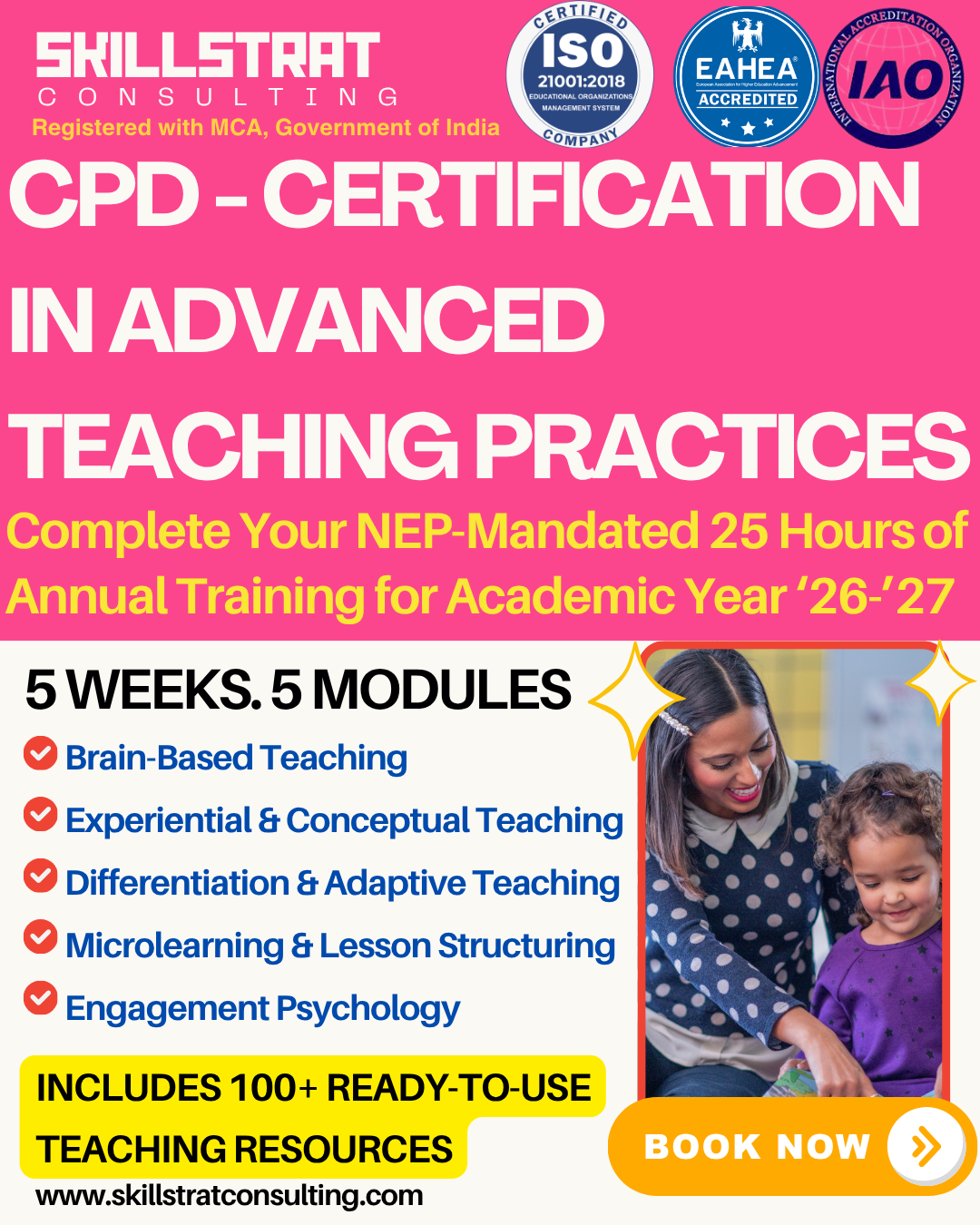
CPD 2: Certification in Advanced Teaching Practices

Wishlist Share

About Course

The Certification in Advanced Teaching Practices (CPD 2) is designed to help educators move beyond foundational teaching strategies and develop deeper, more effective classroom practices aligned with current educational reforms.

With the shift towards competency-based learning, experiential pedagogy, and conceptual understanding, teachers are required to not just deliver content but design meaningful learning experiences. This program focuses on how students learn, how lessons should be structured, and how teaching can be adapted in real time to improve understanding, engagement, and participation.

Across five focused modules, participants will learn to design cognitively aligned lessons, facilitate experiential and concept-driven learning, manage diverse learner needs, structure content effectively, and build engaging classrooms.

The program is practical in nature, with a strong focus on classroom application. Each module is designed to translate directly into teaching practice, ensuring that educators can implement what they learn immediately.

Show More

What Will You Learn?

  • ✔ MODULE 1: BRAIN-BASED TEACHING
  • Understanding how students learn, remember, and retain
  • Understand how attention impacts learning in the classroom
  • Understand how memory works and why students forget
  • Identify cognitive overload and its impact on comprehension
  • Apply simple strategies to improve retention
  • Design lessons that align with how students process information
  • ✔ MODULE 2: EXPERIENTIAL & CONCEPTUAL TEACHING
  • Moving from activities to deep understanding and application
  • Design classroom activities that lead to meaningful learning
  • Use reflection to convert activity into understanding
  • Identify core concepts from any topic or chapter
  • Frame conceptual questions that promote thinking
  • Design tasks that enable application and transfer of learning
  • ✔ MODULE 3: DIFFERENTIATION & ADAPTIVE TEACHING
  • Improve clarity of instruction in the classroom
  • Structure lessons to maintain attention and flow
  • ✔ MODULE 5: STUDENT MOTIVATION & ENGAGEMENT PSYCHOLOGY
  • Driving attention, participation, and interest
  • Identify reasons why students disengage in class
  • Use hooks and curiosity to start lessons effectively
  • Maintain attention through simple engagement strategies
  • Apply key drivers of motivation in classroom tasks
  • Teaching effectively in mixed-ability classrooms
  • Identify different learner levels within a classroom
  • Design tiered tasks for varied learning needs
  • Use simple grouping strategies effectively
  • Adjust teaching based on student responses
  • Ensure participation and learning across all learners
  • ✔ MODULE 4: MICROlearning & LESSON STRUCTURING
  • Designing clear, focused, and effective lessons
  • Break lessons into clear and manageable learning chunks
  • Design short and focused learning cycles
  • Use examples and analogies to improve understanding
  • Use language that encourages participation and confidence

Course Content

Module 1 : Brain-Based Learning: Teaching in Ways the Brain Naturally Learns
This module introduces educators to the foundational principles of Brain-Based Learning and how these principles can transform classroom instruction, student engagement, and long-term retention. Teachers often focus on delivering content, but effective learning depends not only on what is taught — it also depends on how the brain processes, stores, retrieves, and applies information. This module helps educators understand how attention, emotion, memory, meaning-making, challenge, and retrieval influence learning inside the classroom. Participants will explore key neuroscience-informed principles such as emotional safety, patterning, memory systems, productive challenge, and meaningful learning. The module then translates these principles into practical classroom strategies that teachers can immediately apply across subjects and grade levels. The focus of the module is not on “teaching more,” but on designing instruction in ways the brain is naturally designed to learn and remember. Learning Objectives By the end of this module, participants will be able to: Understand the foundational principles of Brain-Based Learning Explain how emotion, memory, attention, and meaning affect learning Differentiate between threat-based learning and productive cognitive challenge Understand the role of working memory and long-term memory in instruction Apply practical classroom strategies that improve retention and engagement Design learning experiences that promote deeper processing and long-term recall Use retrieval, chunking, interleaving, and emotional connection intentionally in lessons

  • Lesson 1 : Introduction to Brain-Based Learning & Its Core Principles
    01:11:41
  • Lesson 2 : How Learning Sticks: Creating Brain-Friendly Learning Conditions
  • Lesson 3 : Practical Brain-Based Teaching Strategies
  • Lesson 4 : Reflection, Classroom Application & Key Takeaways
  • Brain-Based Learning -Module Quiz

Module 2 : Experiential & Concept-Based Learning
This module focuses on two powerful instructional approaches: Experiential Learning and Concept-Based Learning. Together, they help learners transform experiences into understanding and understanding into transferable knowledge. You will begin by exploring Kolb's Experiential Learning Cycle, which explains how learners construct understanding through experience, reflection, conceptualization, and application. You will examine each stage of the cycle, understand the teacher's role within it, and explore practical classroom techniques that make learning active, meaningful, and memorable. The module then introduces Assimilation and Accommodation, helping you understand how students build and modify mental models. You will discover why activities and experiences alone do not guarantee learning, and why concept formation is essential for deep understanding. Building on this foundation, you will explore Concept-Based Learning, an approach that helps students move from isolated facts to patterns, principles, and transferable ideas. Through strategies such as Socratic Questioning, Compare & Contrast, Frayer Models, Concept Attainment, Concept Mapping, and Systems Thinking, you will learn how to help students uncover the "big ideas" that connect knowledge across topics and disciplines. By the end of this module, you will be able to design learning experiences that not only engage students in meaningful experiences but also guide them toward deeper conceptual understanding and real-world application. Rather than teaching students what to think, you will learn how to help them think, connect, transfer, and apply learning across contexts.

Module 3 : Engagement Psychology
In this module, we will explore the psychology behind engagement. Drawing from research on motivation, attention, psychological safety, and flow, we will examine why students disengage, what conditions lead to sustained engagement, and how teachers can intentionally design learning experiences that keep students invested in the learning process. We will also explore how different students engage in different ways, why a strategy that works brilliantly for one learner may fail for another, and what this means for lesson design. By the end of this module, you will be able to move beyond simply managing participation and begin designing classrooms that foster genuine attention, curiosity, ownership, persistence, and deep learning.

Module 4 : Adaptive Teaching & Differentiated Learning
Every classroom is diverse. Students arrive with different levels of readiness, prior knowledge, confidence, interests, learning preferences, and support systems. Yet, teachers are often expected to teach a single lesson to an entire class and achieve meaningful learning for every student. This creates one of the biggest challenges in education: How do we maintain high expectations while ensuring every learner can access, engage with, and succeed in learning? In the previous module, we explored how different learners engage through different motivational pathways. We discovered that there is no single strategy that engages every student equally. This naturally leads to the next question: If students engage differently, should they all be taught exactly the same way? Adaptive Teaching provides the answer. Rather than lowering expectations or creating separate lesson plans for every learner, Adaptive Teaching focuses on making thoughtful adjustments to instruction, support, challenge, pacing, grouping, and assessment so that all students can work toward the same learning goals through different pathways. In this module, we will explore how to identify learner needs, differentiate effectively, scaffold learning without reducing rigor, and create flexible classrooms that support both struggling and advanced learners. By the end of this module, you will be able to design learning experiences that are responsive, inclusive, and challenging for all learners.

Module 5 : Integrated Lesson Design
Great teaching is not about applying isolated strategies. An engaging classroom is created when teachers intentionally combine insights from learning science, experiential pedagogy, engagement psychology, and adaptive teaching into a single coherent lesson. In this capstone module, participants will learn how to integrate all four instructional frameworks to design lessons that are brain-friendly, experiential, engaging, inclusive, and responsive to diverse learner needs.

Student Ratings & Reviews

No Review Yet
No Review Yet