SkillStrat Consulting

Professional Certification in Academic Coordination

Wishlist Share

About Course

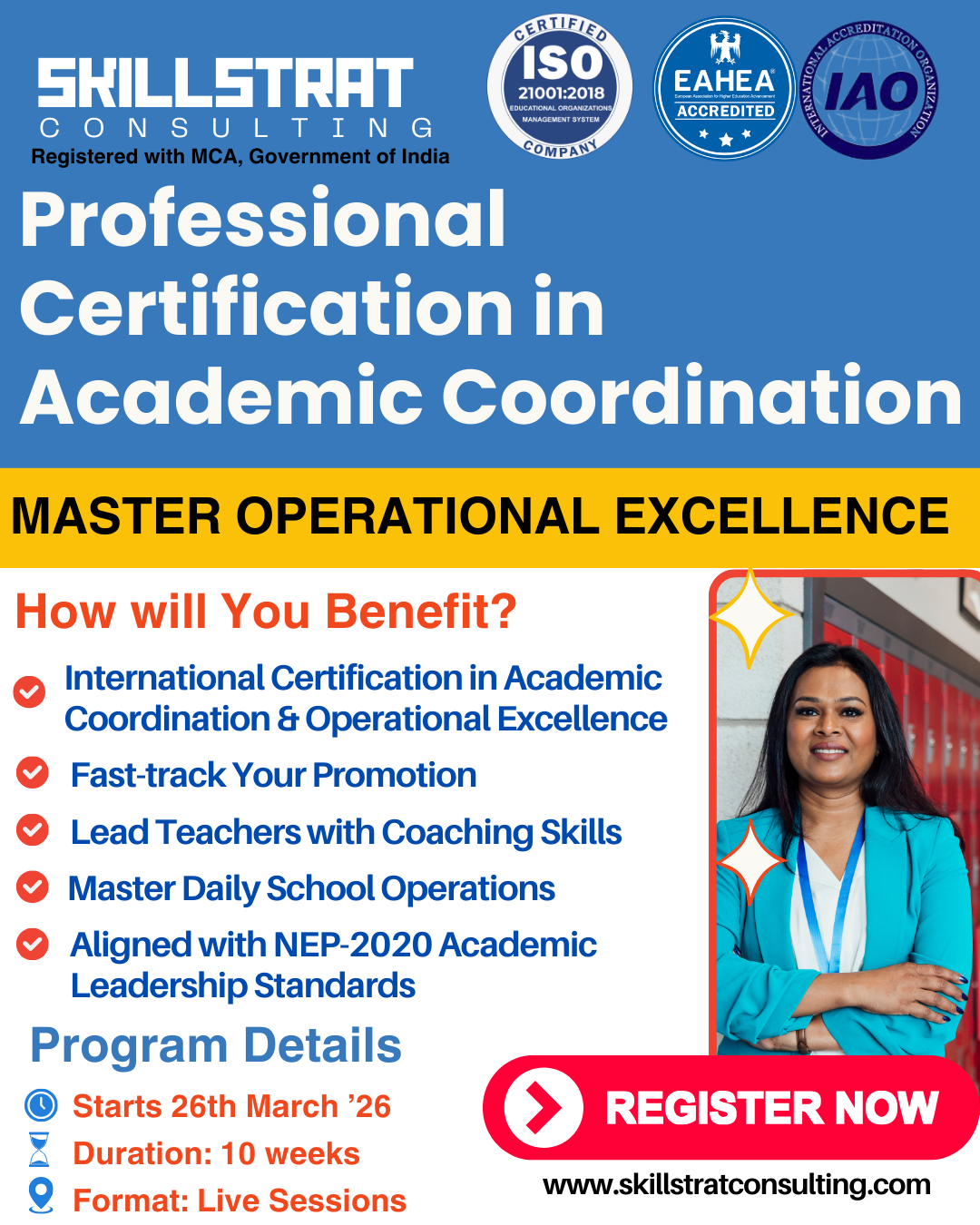
The Professional Certification in Academic Coordination is a structured leadership development program designed for educators who aspire to step into academic coordinator, section head, or HOD roles.

This program equips participants with the practical systems, tools, and leadership competencies required to manage day-to-day academic operations, support teachers through coaching, monitor curriculum implementation, and improve student outcomes through structured academic planning.

Unlike general leadership courses, this certification focuses specifically on academic systems, instructional supervision, assessment management, and operational excellence within schools, aligned with NEP-2020 expectations.

What Will You Learn?

  • • Define and execute the role of an Academic Coordinator with clarity and confidence
  • • Review and improve lesson plans using structured academic frameworks
  • • Design and implement assessment calendars and tracking systems
  • • Conduct effective classroom observations and give constructive teacher feedback
  • • Monitor syllabus completion and curriculum alignment
  • • Use academic data to identify gaps and improve student performance
  • • Plan and manage exams, timetables, substitutions, and academic documentation
  • • Handle parent concerns and academic conflicts professionally
  • • Run structured and outcome-driven staff meetings
  • • Build teacher development plans and support underperforming staff

Course Content

Module 1: Leadership Perspective & Role Clarity
The first module of the Academic Coordination Certification Program focuses on the foundational transformation required to step into academic leadership. Before managing curriculum, assessments, teachers, or academic systems, participants must first develop the mindset, perspective, and thinking patterns of an Academic Coordinator. This module is designed to help participants shift: from classroom-focused thinking to school-wide thinking, from reacting to problems to building systems, and from personal teaching success to collective academic excellence. The module introduces participants to the evolving role of Academic Coordinators as instructional and academic leaders who are responsible not only for execution, but also for oversight, decision-making, systems thinking, and leadership maturity. Participants will explore: The mindset shift from teacher to academic leader The changing expectations of Academic Coordinators The core abilities required for academic leadership Leadership biases and objective decision-making Emotional thinking and leadership reactions Systems thinking and root cause analysis Leadership thinking tools such as: SWOT Analysis Iceberg Model Ripple Effect Analysis Concept Mapping 5-Why Analysis Analytical leadership and evidence-based problem-solving The role and responsibilities of an Academic Coordinator The module emphasizes that effective academic leadership is not about authority or micromanagement. It is about: creating clarity, improving systems, supporting teachers, analyzing problems deeply, and ensuring meaningful student learning outcomes. By the end of this module, participants will begin developing the foundational perspective required to function as reflective, analytical, and systems-oriented academic leaders.

  • Lesson 1 : The Shift from Teacher to Academic Leader
  • Lesson 2: Biases, Emotional Thinking & Objective Leadership
  • Lesson 3: Systems Thinking & Root Cause Analysis for Academic Leaders
  • Lesson 4: The Role & Responsibility of an Academic Coordinator
  • Lesson 5: Leadership Reflection, Professional Identity & The Coordinator Mindset
  • Module 1 Quiz: Leadership Perspective & Role Clarity

Module 2: Curriculum & Academic Planning
Curriculum leadership is one of the most important responsibilities of an Academic Coordinator. However, curriculum is far more than textbooks, syllabus completion, or assessment schedules. Strong Academic Coordinators ensure that what schools plan, what teachers teach, what students experience, and what schools assess all remain meaningfully aligned. This module introduces participants to the foundations of curriculum leadership through the ALIGN–DESIGN–DELIVER Framework, helping them understand how to create competency-driven, outcome-focused, and well-structured academic systems aligned with NEP 2020 and modern instructional practices. Participants will explore concepts such as curriculum alignment, academic planning, competency mapping, assessment design, pacing systems, and instructional coherence to ensure that learning becomes balanced, meaningful, and transformational for every learner.

Module 3: Assessment Systems & Academic Tracking
Design comprehensive assessment calendars. Differentiate between formative and summative systems. Create result tracking sheets and performance dashboards. Identify learning gaps and implement improvement strategies.

Module 5: Academic Operations & Examination Management
Plan exam schedules and duty allocation systems. Manage substitutions and timetable adjustments. Maintain academic documentation and compliance records. Ensure smooth execution of daily school operations.

Module 6: Parent Communication & Academic Conflict Handling
Handle parent complaints with professionalism. Conduct effective PTMs focused on academic growth. Resolve academic conflicts between teachers, students, and parents. Build trust-based communication frameworks.

Module 4: Classroom Observation & Teacher Coaching
Conduct structured classroom observations. Use observation rubrics and feedback tools. Engage in professional coaching conversations. Support struggling teachers through action plans and mentoring cycles.

Module 7: Capstone Project – Academic Systems Implementation
• Design a structured lesson review framework • Create an annual assessment calendar • Develop a classroom observation tool • Present an academic improvement plan Successful completion leads to certification.

Student Ratings & Reviews

No Review Yet
No Review Yet